



One quarter of people who had a fatal overdose had recent interaction with health care system
One in four Ontarians who died of an opioid overdose during the pandemic had an interaction with the health care system in the week prior to their death, suggesting potential missed opportunities for supporting those at risk of overdose, a new report shows.
The report, a follow-up to data released in May 2021, analyzed accidental opioid-related deaths in Ontario from March to December 2020, as well as prior prescription medication and health care use among those who died, to identify opportunities for support and prevention. The report was led by researchers from the Ontario Drug Policy Research Network (ODPRN) at St. Michael’s Hospital of Unity Health Toronto, ICES, the Office of the Chief Coroner for Ontario, and Public Health Ontario.
The data shows people who died from opioid overdose frequently interacted with the health care system — defined as outpatient visits, primary care visits, emergency department visits or hospital admission — in the week and month before death. The findings also show only a quarter of those who died had a recent opioid prescription prior to death and almost half of those prescriptions were for methadone.
“There is often the idea that people who are at risk for overdose are not well-connected to the health care system, but we were struck by the relatively high number of health care encounters in the week and month before people died of an overdose,” said Dr. Gillian Kolla, co-author of the report and a Postdoctoral Fellow at the MAP Centre for Urban Health Solutions at St. Michael’s Hospital. While ensuring access is important, the data also suggests there is work to do to ensure the health care encounters that are occurring are better meeting the needs of people who use drugs, she said.
“Finding that one-quarter of people had been engaged in the health care system in a variety of settings in the week prior to death suggests an important missed opportunity for supporting people at risk of overdose,” said Dr. Tara Gomes, lead author of the report.
“Health care encounters are an opportunity to connect people who use drugs with community-based programs and services — including access to treatment, mental health services, harm reduction and housing support,” said Dr. Gomes, a Scientist at the Li Ka Shing Knowledge Institute of St. Michael’s Hospital and ICES, and a Principal Investigator of the ODPRN.
The authors of the report say the findings support calls for expanded access to low-barrier treatment in multiple health care settings, such as hospitals and primary care; expanded harm reduction services, including supervised consumption sites; access to a safer supply of drugs; and access to affordable housing.
“The loss of lives due to opioid toxicity in Ontario has only deepened during the COVID-19 pandemic. Understanding how people interact with health care providers, support systems and harm reduction services will help develop policies aimed at preventing further opioid-related deaths,” said Dr. Dirk Huyer, Chief Coroner for Ontario.
More than 2,000 people died in Ontario from accidental opioid overdose from March to December 2020. Rates of fatal opioid overdose in Ontario nearly doubled among males during the pandemic and rose 79 percent among individuals aged 25-44. The number of opioid-related deaths among people experiencing homelessness doubled and rates in Northern Ontario were almost three times higher than Southern regions of the province during the pandemic.
Using data from ICES, a not-for-profit research institute, the report found:
- One in four had a health care encounter in the week prior to death and half had an encounter in the month prior to death.
- One in three people who died during the pandemic accessed opioid agonist treatment in the past five years, but only one in 10 in the past 30 days.
- Among people actively treated with methadone at time of death, two-thirds had visited an outpatient clinic in the week prior, highlighting another opportunity to connect people to additional supports.
- Two in three deaths occurred among people with evidence of an opioid use disorder (OUD), meaning a third of fatal overdoses may be occurring among people without OUD diagnoses, or who may only intermittently or occasionally use drugs.
Though the role of prescription opioids was historically focused on as the major contributor to the overdose crisis, the report shows that the unregulated drug supply is primarily responsible for fatal overdoses, with deaths predominantly driven by fentanyl. The report found:
- Non-pharmaceutical opioids were responsible for 89 percent of deaths, the vast majority of which involved fentanyl.
- There was a five-fold increase in the detection of non-pharmaceutical benzodiazepines in fatal opioid poisonings during the pandemic. These drugs are often present in the unregulated opioid drug supply, and can increase sedation and complicate the overdose response when mixed with opioids.
- One in 10 deaths during the pandemic involved only pharmaceutical opioids.
The report, entitled “Patterns of Medication and Healthcare Use Among People who Died of an Opioid-Related Toxicity during the COVID-19 Pandemic in Ontario,” was funded by the Government of Ontario and the Canadian Institutes of Health Research (CIHR).
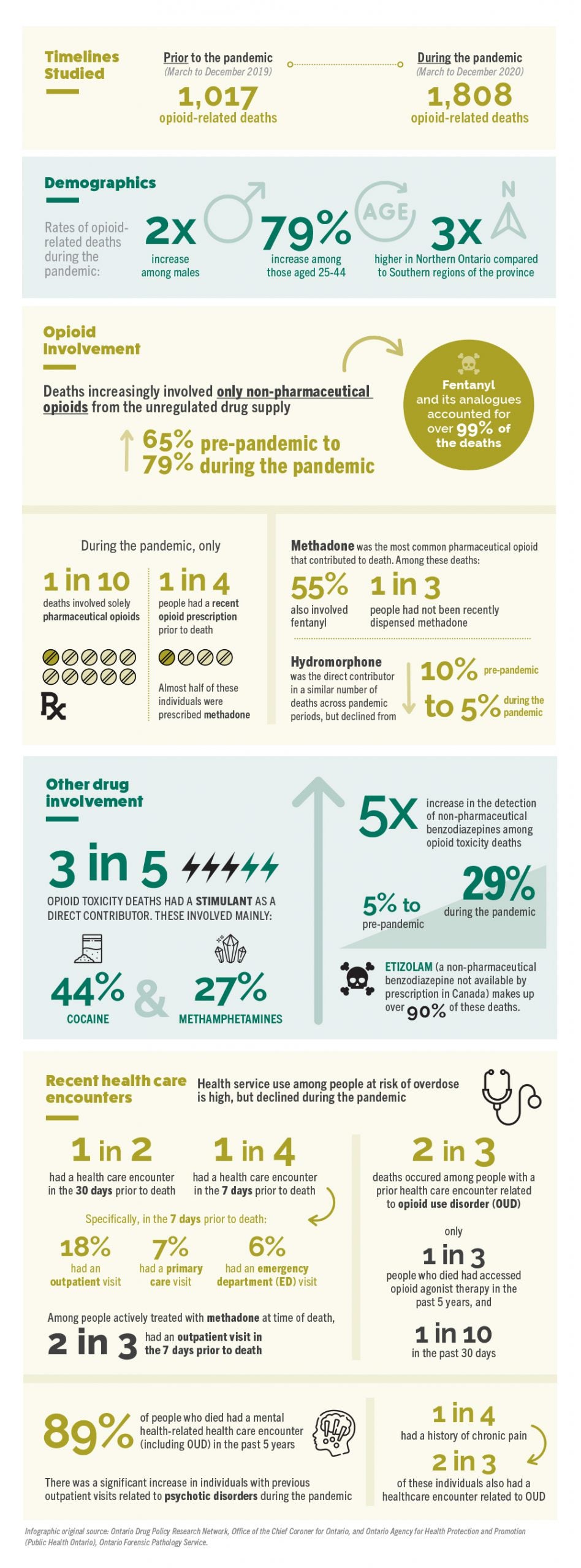
Opioids study findings
The following statistics are from the “Patterns of Medication and Healthcare Use Among People who Died of an Opioid-Related Toxicity during the COVID-19 Pandemic in Ontario” report.
Timelines Studied
Prior to the pandemic (March to December 2019): 1,017 opioid-related deaths
During the pandemic (March to December 2020): 1,808 opioid-related deaths
Demographics
Rates of opioid-related deaths during the pandemic:
- Two-time increase among males
- 79 percent increase among those aged 25-44
- Three-times higher in Norther Ontario compared to Southern regions of the province
Opioid Involvement
- Deaths increasingly involved only non-pharmaceutical opioids from the unregulated drug supply
- The number of deaths increased from 65 percent pre-pandemic to 79 percent during the pandemic
- Fentanyl and its analogues accounted for more than 99 percent of the deaths
During the pandemic, only:
- One in 10 deaths involved solely pharmaceutical opioids
- One in four people had a recent opioid prescription prior to death
- Almost half of these individuals were prescribed methadone
Methadone was the most common pharmaceutical opioid that contributed to death. Among these deaths:
- 55 percent also involved fentanyl
- One in three people had not been recently dispensed methadone
Hydromorphone was the direct contributor in a similar number of deaths across pandemic periods, but declined from 10 percent pre-pandemic to five percent during the pandemic.
Other Drug Involvement
- Three in five opioid toxicity deaths had a stimulant as a direct contributor, which mainly involved 44 percent cocaine and 27 percent methamphetamines.
- Five times increase in the detection of non-pharmaceutical benzodiazepines among opioid toxicity deaths from five percent pre-pandemic to 29 percent during the pandemic.
- Etizolam (a non-pharmaceutical benzodiazepine not available by prescription in Canada) makes up more than 90 percent of these deaths.
Recent Health Care Encounters
Health service use among people at risk of overdose is high, but declined during the pandemic.
- One in two had a health care encounter in the 30 days prior to death
- One in four had a health care encounter in the seven days prior to death
- Specifically, in the seven days prior to death:
- 18 percent had an outpatient visit
- Seven percent had a primary care visit
- Six percent had an emergency department (ED) visit
- Among people actively treated with methadone at time of death, two in three had an outpatient visit in the seven days prior to death
- Two in three deaths occurred among people with a prior health care encounter related to opioid use disorder (OUD).
- Only one in three people who died accessed opioid agonist therapy in the past five years, and one in 10 in the past 30 days
- 89 percent of people who died had a mental health-related health care encounter (including OUD) in the past five years
- There was a significant increase in individuals with previous outpatient visits related to psychotic disorders during the pandemic
- One in four had a history of chronic pain
- Two in three of these individuals also had a health care encounter related to OUD
Infographic original source: Ontario Drug Policy Research Network, Office of the Chief Coroner for Ontario, and Ontario Agency for Health Protection and Promotion (Public Health Ontario), Ontario Forensic Pathology Service.


